

How Long Should You Percolate Coffee in a Household Coffee Percolator for the Best Flavor
2026-08-11
The brewing time in a household coffee percolator directly determines whether your morning cup turns out richly aromatic or painfully bitter. Unlike automatic drip machines, a household coffee percolator circulates boiling water through the grounds repeatedly, which means every extra minute changes the chemical extraction. For home brewers seeking consistency, Sunnex has engineered percolators with visible brew cycles and heat indicators, but even the best equipment requires precise timing. So what is the golden window for percolation?
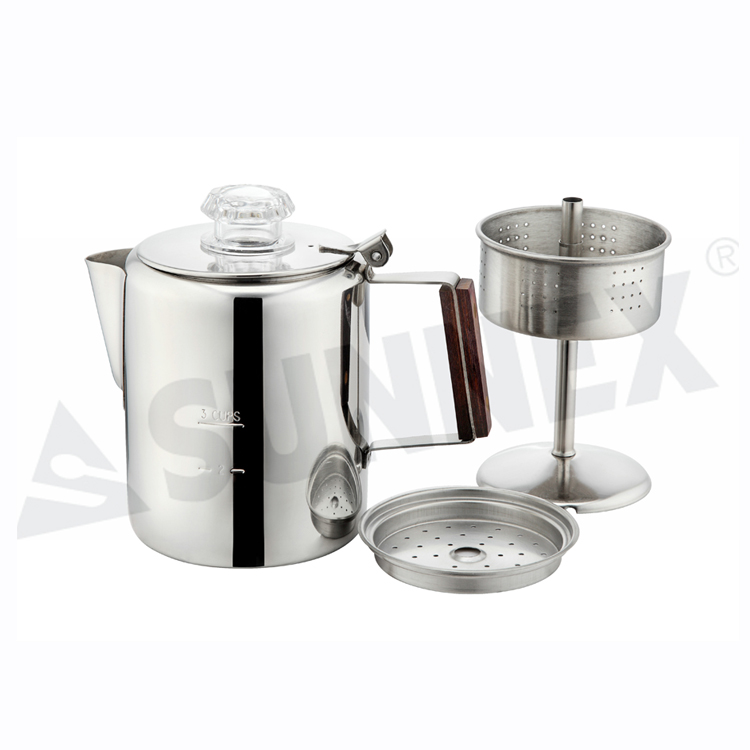
The Science of Percolation Time
Coffee extraction follows a logarithmic curve. In the first 3–4 minutes, water dissolves sugars, organic acids, and fruity esters—this is where brightness and complexity live. Between 5–7 minutes, you extract melanoidins and caramelized compounds that create body and depth. Beyond 8 minutes, tannins, chlorogenic acid lactones, and bitter alkaloids dominate, turning your brew into an astringent mess.
| Time (Minutes) | Extraction Phase | Flavor Profile | Recommended Use |
|---|---|---|---|
| 3 – 4 | Light acids & esters | Bright, fruity, tea-like | Light roasts, single origins |
| 5 – 6 | Balanced mid-range | Full-bodied, sweet, round | Medium-dark blends |
| 7 – 8 | Heavy compounds | Bitter, smoky, sharp | Dark roasts (only if monitored) |
| 9+ | Over-extraction | Harsh, metallic, hollow | Avoid entirely |
For most household coffee percolators, the optimal total brew time—from first bubble to flame off—is 6 to 7 minutes for a standard medium grind. However, this window shrinks or expands based on three variables: grind size, water temperature, and percolator material. Sunnex stainless steel models retain heat more evenly than aluminum, reducing the risk of scorching at the 7‑minute mark.
Step‑by‑Step Timing Guide
-
Start with cold, filtered water – Heating from cold ensures gradual extraction. Set your stovetop to medium heat (not high).
-
Watch for the first percolation “spurt” – This usually occurs at 3–4 minutes. That is your official start time.
-
Reduce heat to low‑medium – Once percolation begins, lower the flame to maintain a gentle “burble” (not a violent boil).
-
Set a timer for 6 minutes – For a 8‑cup Sunnex percolator, 6 minutes produces a crowd‑pleasing balance.
-
Remove from heat immediately – Residual heat continues brewing, so transfer to a serving carafe or serve right away.
Pro tip from Sunnex labs: If your percolator has a glass knob, watch the color. When the liquid turns from pale amber to deep mahogany, you have approximately 45 seconds before bitterness sets in.
Grind Size & Time Adjustments
| Grind Size | Recommended Time | Why |
|---|---|---|
| Coarse (like sea salt) | 7 – 8 minutes | Slower extraction; needs more contact |
| Medium (sand-like) | 5½ – 6½ minutes | Ideal for most household percolators |
| Fine (table salt) | 4 – 5 minutes | Extracts very fast; shorten time to avoid over‑bitterness |
If you use a fine grind in a household coffee percolator, reduce heat earlier and stop at 4½ minutes. Conversely, coarse grinds benefit from the full 8‑minute cycle, especially with Sunnex’s even‑heat dispersion base.
Frequently Asked Questions About Household Coffee Percolators
Q1: Does the altitude or room temperature affect percolation time in a household coffee percolator?
A: Yes, significantly. At higher altitudes (above 3,000 feet), water boils at a lower temperature (around 203°F instead of 212°F). This slows extraction, so you may need to add 1–2 extra minutes to reach the same flavor level. In cold kitchens (below 60°F), the percolator’s metal body loses heat faster; pre‑warm the unit with hot tap water before starting. Sunnex percolators with thick‑gauge stainless steel minimise this fluctuation, but always taste‑test your first batch at a new location.
Q2: Can I reuse the same coffee grounds for a second cycle in a household coffee percolator to save money?
A: Technically yes, but flavor quality plummets. After the first 6‑minute cycle, over 85% of soluble compounds are already extracted. A second cycle pulls only bitter lignin and cellulose fibers, producing a weak, stale, and astringent cup. If you must reuse, reduce the second brew to 3 minutes and blend it with fresh coffee—but Sunnex recommends using fresh grounds every time for any percolator, as the marginal cost savings rarely justify the taste compromise.
Q3: How do I know if my household coffee percolator is percolating too fast or too slow during those 6 minutes?
A: Watch the perc rate through the glass knob or stem. Ideal percolation is 2–3 “spurts” per second. If you see 5+ spurts per second, your heat is too high—this causes channeling (water rushing through cracks in the grounds) and uneven extraction, so lower the flame immediately. If you see fewer than 1 spurt per second, the water isn’t circulating properly; increase heat slightly and check that the stem and basket are not clogged. Sunnex models include a visible flow indicator, making this adjustment intuitive even for first‑time users.
Final Verification: The Taste Test
Brew two batches in your household coffee percolator—one at 5 minutes, one at 7 minutes—using the same grind and water. Cool each to 160°F and sip side‑by‑side. The 5‑minute brew will taste lively but thin; the 7‑minute brew will feel heavier with a lingering finish. Your personal sweet spot lies between them. For most dark roasts, Sunnex engineers consistently find 6 minutes and 15 seconds to be the universal baseline.
Contact Us
Perfecting your percolation time is a journey, not a guess. Whether you are troubleshooting a bitter batch or upgrading to a more consistent brewer, the Sunnex team is here to help. Visit our official website for model‑specific timing charts, or reach out to our coffee specialists directly—we reply within 24 hours with personalised recommendations for your stove type, grind preference, and household size. Contact us today and let us help you unlock the full potential of your household coffee percolator. Every cup deserves precision, and every brewer deserves Sunnex.