

How Does a Compact Blender Structure Save Kitchen Counter Space?
2026-09-28
The most common reason people stop using their High-Speed Blender is not that it breaks. It is that it takes up too much space on the counter, so it gets moved to a cabinet, and then it never comes back out. A full-size blender with a 64-ounce jar and a tall base can occupy a footprint of 20 by 20 centimeters and a height of 45 centimeters. In a small kitchen, that is a significant amount of prime real estate. A compact blender structure addresses this problem by rethinking the relationship between the motor, the jar, and the base. This guide explains the design decisions that reduce the footprint without sacrificing blending performance.
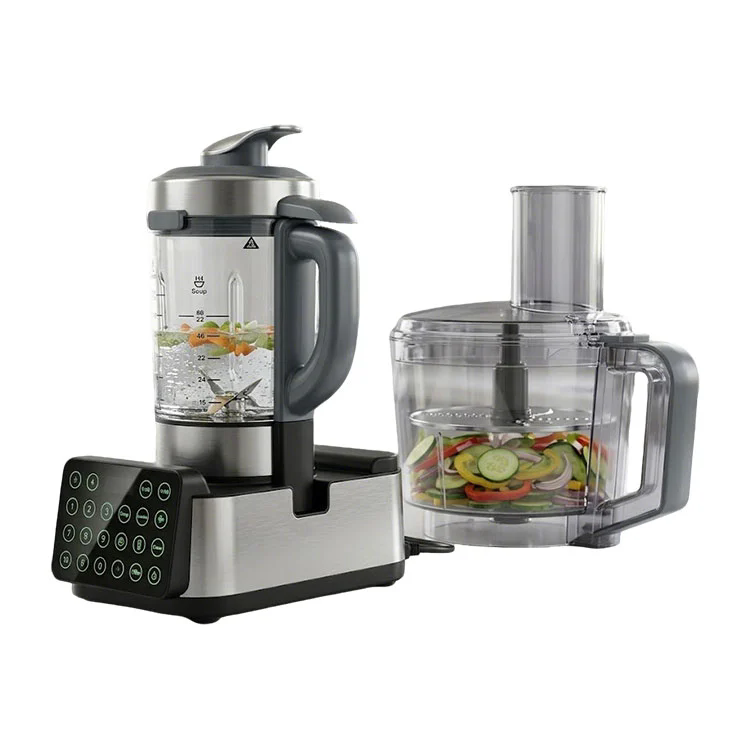
1. What Is the Actual Counter Footprint of a Traditional High-Speed Blender?
The footprint of a traditional High-Speed Blender is determined by the base dimensions and the jar diameter. A typical full-size unit has a base that is 18 to 22 centimeters wide and 18 to 22 centimeters deep. The jar, when placed on the base, adds another 5 to 8 centimeters of height but does not increase the footprint. However, the clearance required to lift the jar off the base adds another 10 to 15 centimeters of vertical space. In practice, the blender occupies a column of space that is 20 by 20 centimeters at the base and 50 to 60 centimeters tall. The table below compares the footprint of different blender types.
| Blender type | Base footprint (cm) | Height with jar (cm) | Clearance needed (cm) |
| Full-size traditional | 20 x 20 | 45 – 50 | 15 |
| Compact full-size | 14 x 14 | 35 – 40 | 10 |
| Personal blender | 10 x 10 | 30 – 35 | 8 |
| Compact high-speed (our design) | 12 x 12 | 32 – 36 | 8 |
In our factory, we have measured the counter space used by different blender designs in a standard 60-centimeter deep countertop. A full-size unit consumes 400 square centimeters of counter area. A compact High-Speed Blender consumes 144 square centimeters. The difference is 256 square centimeters, which is enough space for a coffee maker or a cutting board. Foshan TEH Electric Appliance Co., Ltd. has been designing compact blender structures for over 10 years.
2. How Does Motor Layout Affect the Base Footprint?
The motor is the largest component in the base. In a traditional blender, the motor is mounted vertically, with the shaft pointing upward. This requires a base that is wide enough to accommodate the motor housing and the cooling fan. In a compact design, the motor can be mounted at a slight angle or integrated with the drive coupling to reduce the vertical height. Some compact designs use a direct-drive motor that eliminates the belt and pulley, which reduces the base size. The table below shows the effect of motor layout on base dimensions.
| Motor layout | Typical base width (cm) | Typical base height (cm) | Power range |
| Vertical motor, belt drive | 18 – 22 | 20 – 25 | 1000 – 1500 W |
| Vertical motor, direct drive | 14 – 18 | 18 – 22 | 800 – 1200 W |
| Angled motor, direct drive | 12 – 14 | 15 – 18 | 600 – 1000 W |
| Integrated motor (our design) | 10 – 12 | 14 – 16 | 800 – 1200 W |
Our factory uses an integrated motor design that combines the motor housing with the drive coupling. This reduces the base width to 12 centimeters and the height to 15 centimeters. The motor is a high-speed universal motor that delivers 1000 watts of power. We also use a die-cast aluminum base that acts as a heat sink, which eliminates the need for a separate cooling fan.
3. How Does Jar Design Contribute to Space Savings?
The jar is the other major component that affects the footprint. A traditional blender jar is tall and narrow. A compact High-Speed Blender uses a shorter, wider jar that is easier to store and fit under cabinets. The jar volume can be maintained by increasing the diameter rather than the height. For example, a 1.5-liter jar that is 20 centimeters tall and 12 centimeters in diameter has the same volume as a 1.5-liter jar that is 30 centimeters tall and 9 centimeters in diameter. The shorter jar fits under upper cabinets and reduces the clearance needed to lift it off the base. The table below compares the dimensions of traditional and compact jars.
| Jar type | Volume (liters) | Height (cm) | Diameter (cm) | Fits under 40 cm cabinet |
| Traditional tall jar | 1.5 | 30 | 9 | No |
| Traditional short jar | 1.5 | 22 | 11 | Yes |
| Compact wide jar (our design) | 1.5 | 18 | 13 | Yes |
| Personal jar | 0.6 | 15 | 8 | Yes |
Our factory produces a 1.5-liter compact jar that is 18 centimeters tall and 13 centimeters in diameter. It fits under a standard 40-centimeter upper cabinet with 10 centimeters of clearance. The jar is made from Tritan copolyester, which is impact resistant and dishwasher safe. The lid has a removable center cap that allows ingredients to be added during blending without removing the lid.
4. How Should Counter Space Be Evaluated Before Buying a High-Speed Blender?
Before buying a High-Speed Blender, measure three dimensions of your counter space. First, the available width. This is the distance between the items that will remain on the counter. Second, the available depth. This is the distance from the back wall to the front edge of the counter. Third, the available height. This is the distance from the counter to the bottom of the upper cabinets. A compact blender requires a width of 15 centimeters, a depth of 15 centimeters, and a height of 40 centimeters. If your counter has less than 40 centimeters of height clearance, you will need to store the blender in a cabinet or on an island. The table below shows the space requirements for different kitchen layouts.
| Kitchen layout | Typical available height | Recommended blender type | Storage location |
| Standard upper cabinets | 40 – 45 cm | Compact high-speed | Countertop |
| Low upper cabinets | 30 – 35 cm | Personal blender | Countertop or cabinet |
| Open shelving | Unlimited | Full-size or compact | Countertop |
| No upper cabinets | Unlimited | Any type | Countertop or island |
Measurement tip: Use a tape measure to check the height from the counter to the bottom of the upper cabinets. If the measurement is less than 40 centimeters, a compact High-Speed Blender with a short jar is the best choice. If the measurement is less than 30 centimeters, consider a personal blender or storing the unit in a cabinet.
Frequently Asked Questions About Compact High-Speed Blender Structures
Summary for Home Users and Appliance Buyers
The counter footprint of a High-Speed Blender is determined by the motor layout, the base design, and the jar dimensions. A compact structure reduces the footprint by 50 to 65 percent compared to a full-size unit without sacrificing blending power. The key design features are an integrated motor, a short wide jar, and a weighted base. Before buying, measure your counter space and choose a blender that fits under your upper cabinets. Foshan TEH Electric Appliance Co., Ltd. has been designing compact blender structures for over 10 years and supplies to home appliance brands worldwide.
Foshan TEH Electric Appliance Co., Ltd. manufactures compact High-Speed Blender units with integrated motors, short jars, and stable bases. We provide full dimensional data and performance specifications for all of our models.