

Article Summary: Choosing kitchen utensils involves more than finding attractive colors or filling a utensil holder. The right tools should protect cookware, feel comfortable during repetitive tasks, handle everyday cooking temperatures appropriately, and remain easy to clean. An ergonomic silicone kitchen utensil kit with wooden handle combines flexible cooking heads with the natural feel of wood to address many common kitchen frustrations. This guide explores material benefits, ergonomic design, essential utensils, food-contact safety, cleaning practices, purchasing considerations, and practical advice for households, retailers, and kitchenware buyers.
Whether you are equipping a first apartment, refreshing a busy family kitchen, or sourcing products for a kitchenware brand, understanding the details behind this utensil combination can help you make a more informed purchase.
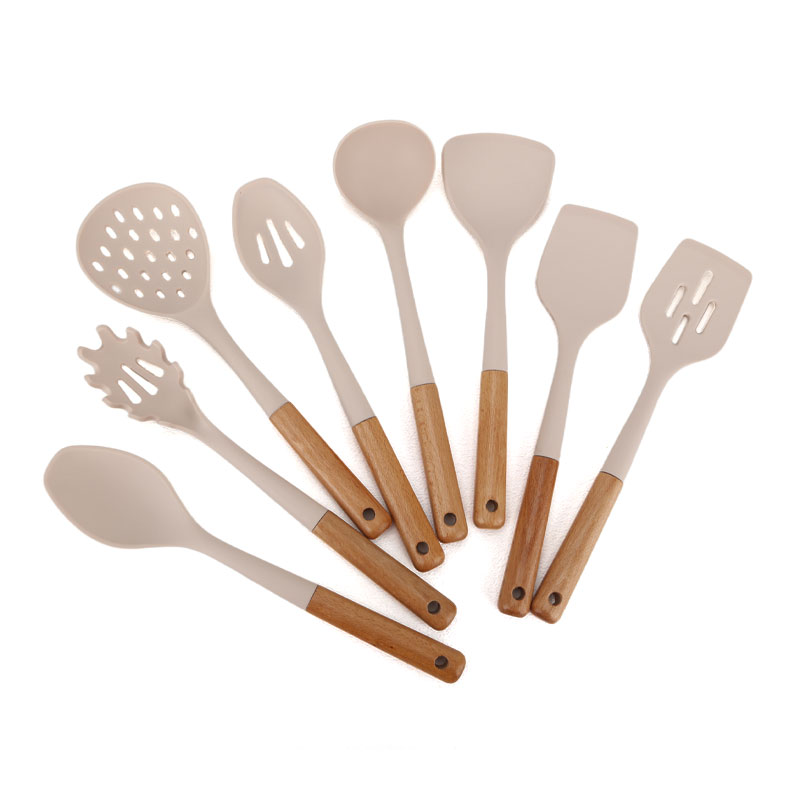
1. Everyday Cooking Problems That the Right Utensils Can Solve
Cooking should be a creative and satisfying activity, but unsuitable kitchen tools can make even a simple meal unnecessarily frustrating. A spatula that scratches a non-stick pan, a spoon with an uncomfortable grip, or a utensil that is difficult to clean can turn repeated daily tasks into avoidable problems.
Protecting delicate cookware surfaces
Non-stick frying pans and coated saucepans need suitable utensils. Metal edges and rough tools can scratch or damage certain coatings, particularly when used forcefully. Silicone cooking heads are generally softer and more flexible than metal, making them a practical option for stirring, folding, scraping, and turning food in compatible cookware.
Making repetitive cooking tasks more comfortable
Stirring a thick sauce, mixing cake batter, or preparing several dishes can involve repeated gripping and wrist movements. A well-shaped handle can make utensils easier to hold and control. Wooden handles offer a natural, familiar feel, while suitable dimensions and balanced weight can help improve handling during ordinary cooking.
Reducing kitchen clutter
Buying individual tools often results in mismatched utensils, duplicate functions, and unnecessary storage problems. A coordinated kit groups frequently used tools together, helping households organize drawers and countertops. Depending on the set configuration, a holder may also keep commonly used items within easy reach.
2. How Silicone and Wooden Handles Work Together
The appeal of an ergonomic silicone kitchen utensil kit with wooden handle lies in the combination of two materials with different characteristics. Silicone is used for the working end of the utensil, while wood provides a distinctive handle surface and a warm, natural appearance.
These advantages depend on the actual product construction. Silicone quality, handle finish, connection design, dimensions, and manufacturing consistency all influence the finished utensil's performance. Buyers should evaluate the specifications of the particular set rather than assume that every product made from these materials offers identical results.
Why the connection between the head and handle matters
The joint is an important inspection point. A loose connection may affect control, while gaps around the joint can trap moisture or food residue. Look for a stable assembly, smooth finishing, and a design that is easy to inspect and clean. If the silicone head is removable, confirm that the manufacturer provides clear instructions for removing and reattaching it.
3. What Ergonomic Design Really Means in a Kitchen
Ergonomics is about how comfortably and effectively a product fits the person using it. For kitchen utensils, this includes handle shape, diameter, length, weight, surface texture, balance, and the amount of control needed to complete a task.
Grip and handle dimensions
A handle that is too thin may require a tight grip, while one that is too thick may feel awkward for people with smaller hands. The ideal dimensions depend on the user and the intended task. Rounded edges, a smooth finish, and an easy-to-hold profile can make a utensil more pleasant to use.
Weight and balance
A utensil should feel manageable when lifting food, stirring a pot, or scraping a bowl. A handle that is excessively heavy or poorly balanced may become tiring during prolonged use. When possible, hold a sample before placing a large order, especially if the product is intended for frequent daily cooking.
Length and reach
Handle length affects how comfortably a user can reach into a deep pot or mixing bowl. Longer handles may provide additional distance from hot food, but they also require suitable storage space and control. Select dimensions according to cookware depth, cooking habits, and storage arrangements.
Matching the utensil to the user
- Everyday home cooks: Prioritize comfortable handling, versatile tools, and simple maintenance.
- Frequent bakers: Look for flexible spatulas that can scrape bowls and fold mixtures effectively.
- People with limited grip strength: Consider handle diameter, weight, balance, and ease of control before purchasing.
- Small kitchens: Choose a set with essential tools and a compact storage solution.
Ergonomic features can improve usability, but they do not guarantee that every person will experience less fatigue. Individual comfort varies, so physical samples and user feedback are valuable when selecting products.
4. Which Essential Tools Should a Complete Kit Include?
The best utensil kit is one that matches everyday cooking needs. Piece counts vary among manufacturers, so compare the actual tools included rather than relying on the number printed on the packaging.
| Utensil | Primary Function | What to Check |
|---|---|---|
| Slotted turner | Flipping eggs, pancakes, and vegetables | Thin, flexible edge and suitable head width |
| Solid spatula | Turning food and stirring ingredients | Balance, flexibility, and surface finish |
| Silicone scraper | Removing batter and sauces from bowls | Edge flexibility and bowl compatibility |
| Cooking spoon | Stirring vegetables, sauces, and other dishes | Bowl depth, handle length, and grip |
| Soup ladle | Serving soups, broths, and liquid foods | Capacity, balance, and pouring control |
| Whisk | Mixing eggs, dressings, and light batters | Wire or head construction and cleaning access |
| Tongs | Turning or lifting food | Grip control, locking mechanism, and safe edges |
Not every kit includes all these items, and certain tools may use stainless steel or another material rather than silicone. Review the product list carefully to avoid paying for accessories you rarely use or missing a tool essential to your cooking routine.
Prioritize versatility over piece count
A smaller set of well-designed utensils can offer better value than a large collection of low-use accessories. Begin with a turner, cooking spoon, and flexible spatula if these match your regular meals. Add a ladle, whisk, or tongs when your cooking style requires them.
5. Silicone, Wood, and Stainless Steel: Understanding the Differences
Each material has a useful place in the kitchen. Comparing their practical characteristics helps buyers choose tools according to cookware compatibility, maintenance preferences, and cooking tasks.
| Material | Key Strength | Potential Limitation | Common Uses |
|---|---|---|---|
| Silicone | Flexible and generally gentle on compatible coated cookware | Quality and temperature limits vary by product | Scraping, stirring, folding, turning |
| Wood | Natural grip and warm appearance | Requires appropriate drying and care | Spoons, spatulas, serving tools |
| Stainless steel | Rigid construction and good resistance to ordinary kitchen wear | May scratch some non-stick surfaces | Whisks, tongs, tools for suitable cookware |
| Hard plastic or nylon | Lightweight and available in varied shapes | Temperature resistance depends on the material and construction | Serving, mixing, and general cooking |
For kitchens with coated pans, silicone heads are often a sensible option because they are less likely to scratch compatible surfaces during normal use. Stainless steel remains useful for tasks requiring rigidity, while wood can provide a traditional cooking experience. The materials can complement one another rather than compete for a single role.
When comparing products, avoid judging quality by appearance alone. Material grade, construction, quality control, and care instructions are more informative than color or style by itself.
6. Food Safety and Heat Resistance: What Buyers Need to Know
Kitchen utensils contact food directly, so material suitability and correct use are essential. The words “silicone” and “wooden handle” do not, by themselves, establish that a product meets every food-contact requirement or can withstand every cooking temperature.
Verify food-contact suitability
Ask the supplier for the applicable food-contact compliance information, supporting test reports, and material specifications for the intended destination market. Requirements can vary by country, product category, and sales channel. Documentation should relate to the actual product and materials being purchased.
Check the stated temperature limit
Silicone utensils can be heat resistant, but their safe operating limits vary by formulation and product design. Follow the manufacturer's stated temperature range, and do not leave a utensil resting against a hot pan for longer than its instructions permit. A high-temperature rating for the silicone head does not mean that the entire utensil, including its wooden handle and adhesive or connection, has the same rating.
Prevent cross-contamination
- Wash utensils before first use and after each use.
- Clean thoroughly after contact with raw meat, seafood, eggs, or other foods requiring careful handling.
- Use separate utensils when necessary to prevent cross-contamination between raw and ready-to-eat foods.
- Inspect the head, handle, and joint regularly for cracks, loose parts, persistent odors, or trapped residue.
- Replace utensils that are badly damaged or cannot be cleaned effectively.
7. How to Choose the Right Ergonomic Silicone Kitchen Utensil Kit With Wooden Handle
Whether buying one set for a household or sourcing hundreds for retail, a structured evaluation helps prevent disappointment and unnecessary costs.
Step 1: Define your cooking requirements
List the dishes you prepare most often and identify the tools you reach for every day. Families that cook soups and stir-fries may need a deep spoon and turner, while baking enthusiasts may value flexible scrapers and spatulas more highly.
Step 2: Inspect the silicone head
Check flexibility, edge finish, shape consistency, and the ability to reach into the cookware you use. The head should perform its intended task without feeling excessively floppy or rigid. Ask for material information and relevant test documentation when purchasing from a supplier.
Step 3: Evaluate the wooden handle
Look for a smooth finish without splinters, rough edges, or visible defects. Consider the handle diameter and length, and check that the finish is suitable for the intended kitchen use. Ask how the handle should be washed and dried.
Step 4: Examine the assembly
Inspect the joint for looseness, visible gaps, and signs of weak construction. Where possible, test the utensil using its intended task rather than relying solely on photographs. For bulk orders, evaluate production samples before approving the full order.
Step 5: Compare the complete cost
The lowest initial price does not always provide the best value. Consider the number of useful tools, packaging quality, expected service life, shipping arrangements, replacement needs, and supplier support. For commercial orders, clarify minimum order quantities, customization charges, lead times, and inspection procedures before confirming the purchase.
Step 6: Check storage and presentation
A utensil holder can keep tools organized, but the holder is not necessarily included with every set. Confirm its inclusion, dimensions, drainage design, and countertop footprint. If the product is intended as a gift, examine packaging protection and how the set will appear when presented to the recipient.
- Suitable utensils for the intended cooking tasks
- Comfortable grip, useful handle length, and manageable weight
- Clearly stated material specifications and temperature limits
- Stable construction and smooth finishing
- Clear cleaning and maintenance instructions
- Appropriate packaging, delivery terms, and supplier documentation
8. Cleaning and Maintenance for Longer Everyday Use
Simple care habits can help preserve the appearance and functionality of a silicone-and-wood utensil set. The most important principle is to clean food-contact surfaces thoroughly while avoiding unnecessary exposure of wooden components to water and heat.
After every cooking session
- Rinse away food residue before it dries whenever practical.
- Wash the silicone head with warm water and a suitable dishwashing detergent.
- Clean around the connection carefully, following the product's instructions.
- Wipe the wooden handle with a damp cloth or wash it only as directed by the manufacturer.
- Dry the utensil completely before placing it in a drawer or holder.
Habits that help prevent premature wear
- Do not soak wooden handles for extended periods.
- Avoid prolonged exposure to direct heat, open flames, and hot cookware edges.
- Do not use abrasive cleaners or tools that may damage the silicone surface or wood finish.
- Store utensils in a dry, ventilated place rather than leaving them in standing water.
- Inspect frequently used utensils periodically, especially around the head-to-handle joint.
Wood may naturally change appearance with use, but deep cracks, splintering, loose joints, or persistent contamination are reasons to stop using a utensil. Replace damaged pieces rather than continuing to use them with food.
9. What Retailers and Wholesale Buyers Should Evaluate
For retailers, importers, distributors, and private-label kitchenware brands, the buying decision extends beyond household usability. Product consistency, communication, documentation, packaging, and supply arrangements can influence customer satisfaction and the long-term value of a product line.
Review the product specification in detail
Request a complete list of included utensils, material descriptions, dimensions, colors, weight, packaging details, and care instructions. Confirm whether the wooden handles are solid wood, another wood-based material, or a different construction before using specific material claims in product listings.
Arrange samples and quality checks
Pre-production or reference samples allow buyers to evaluate grip comfort, finish, balance, assembly, and packaging. For repeat orders, agree on a clear specification and inspection criteria so that subsequent batches can be compared against the approved sample.
Consider customization and market fit
Retail programs may require custom colors, branding, gift boxes, barcodes, or specific set combinations. Confirm which options are available, any additional costs, and the effect on minimum order quantities and production schedules. Ensure all product claims and labels match the final approved design and applicable local requirements.
Assess the supplier relationship
Reliable communication and clear documentation are important when resolving product questions, coordinating samples, or planning repeat orders. Buyers should compare suppliers on product suitability, quality management, responsiveness, delivery arrangements, and overall commercial terms instead of relying on price alone.
10. Discover Kitchenware Solutions With Ningbo JAS Home Supplies Co., Ltd.
Ningbo JAS Home Supplies Co., Ltd. focuses on kitchenware and household cooking products, including silicone, wooden, and stainless steel utensils, as well as cookware and kitchen accessories. Its product range serves buyers looking for practical tools that combine everyday functionality with coordinated design.
For businesses developing a kitchenware collection, supplier discussions can help clarify available product styles, material options, customization requirements, sample arrangements, and order conditions. The company also describes OEM/ODM customization services, making it worth discussing project requirements directly when developing a tailored product assortment.
When evaluating an ergonomic silicone kitchen utensil kit with wooden handle, buyers should provide their preferred tool combination, target market, estimated order quantity, packaging needs, and any required compliance documentation. This makes it easier to establish whether the proposed product fits the intended application.
Product specifications, customization availability, order quantities, testing documents, and delivery schedules should be confirmed directly with the supplier for the specific item and market.
11. Frequently Asked Questions
1. Are silicone kitchen utensils with wooden handles suitable for non-stick pans?
They are generally a practical choice for compatible non-stick cookware because silicone heads are softer than metal utensils. Avoid forceful scraping, inspect the utensil for damage, and follow the cookware manufacturer's care instructions.
2. Can wooden-handled silicone utensils withstand high temperatures?
The permitted temperature depends on the particular product and its construction. Check the manufacturer's specified operating range, and remember that the wooden handle and joint may have different limitations from the silicone head.
3. Can I put the complete utensil kit in a dishwasher?
Not necessarily. Wooden handles may be damaged by prolonged heat, moisture, and dishwasher detergents. Use a dishwasher only if the manufacturer explicitly confirms that the complete utensil is dishwasher safe.
4. How many pieces should a kitchen utensil kit contain?
There is no universal ideal number. A compact set of essential tools may suit small households, while larger families or cooking enthusiasts may benefit from additional spoons, turners, ladles, whisks, or tongs. Choose based on actual usage.
5. How can buyers assess silicone material quality?
Request detailed material specifications and relevant food-contact test reports. Inspect the finished product for inconsistent surfaces, defects, strong persistent odors, and poor assembly. Product appearance alone cannot verify material composition or compliance.
6. Do wooden handles require special maintenance?
Yes. Follow the manufacturer's cleaning instructions, avoid prolonged soaking, dry the handle thoroughly, and store it in a ventilated area. These practices help limit moisture-related damage and preserve the finish.
7. What should importers ask before placing a bulk order?
Confirm product specifications, sample approval, available customization, minimum order quantity, packaging, production lead time, inspection arrangements, shipping terms, and market-specific compliance documents. Written confirmation helps reduce misunderstandings.
8. Can the utensil kit be customized for a private-label brand?
Customization depends on the supplier's capabilities and the specific project. Ask about available colors, utensil combinations, logos, packaging, tooling requirements, minimum quantities, and additional costs before finalizing a design.
9. How should a damaged silicone utensil be handled?
Stop using it if the head is cracked, torn, badly degraded, or separating from the handle. Replace utensils that cannot be cleaned properly or that show structural damage, particularly when they contact food directly.
10. What makes an ergonomic utensil set worth buying?
A worthwhile set combines useful tool selection, comfortable handling, suitable materials, reliable construction, manageable cleaning requirements, and a price appropriate to its expected use. A well-matched set is more valuable than a large collection of tools that rarely leave the drawer.
12. Make Everyday Cooking More Comfortable and Organized
An ergonomic silicone kitchen utensil kit with wooden handle can bring together flexible cooking performance, a natural grip, coordinated styling, and practical everyday functionality. Its value depends on more than appearance: material suitability, handle comfort, assembly quality, temperature limits, and maintenance requirements all deserve attention.
For household buyers, the best approach is to choose utensils that match real cooking habits and existing cookware. For retailers and importers, clear specifications, sample evaluation, product documentation, and dependable supplier communication are essential steps toward a successful purchase.
Whether you are upgrading a home kitchen or developing a new kitchenware collection, Ningbo JAS Home Supplies Co., Ltd. can be contacted to discuss product options and project requirements.
Looking for a Kitchenware Supplier for Your Next Project?
Explore practical kitchenware solutions with Ningbo JAS Home Supplies Co., Ltd. Share your preferred utensil styles, target market, customization ideas, and order requirements to start a product discussion.
Visit the company profile for more information, or contact us to discuss samples, product specifications, and potential cooperation.
Contact Us & Explore Solutions