

Can Wrinkle-free Catering Airline Aluminum Foil Containers Withstand Extreme Temperature Changes
2026-07-06
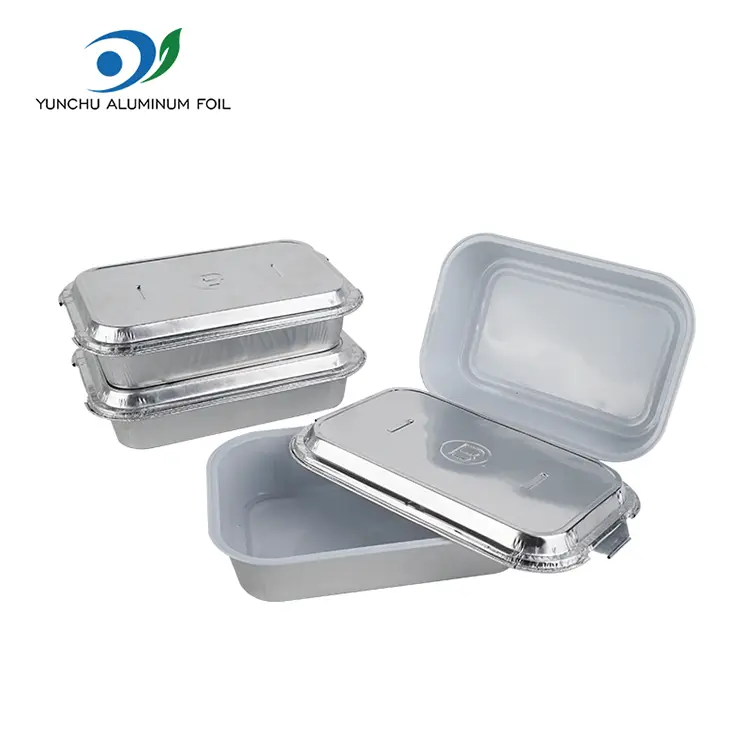
In the high-altitude environment of commercial aviation, catering equipment faces one of the most demanding thermal cycles in the food service industry. Meals are prepared in ground kitchens at room temperature, blast-chilled to below 5°C, loaded into aircraft galley carts, reheated in convection ovens at 180–220°C, and then served within a narrow time window. This rapid transition from deep cold to intense heat places extraordinary stress on food packaging. Wrinkle-free Catering Airline Aluminum Foil Containers have emerged as the industry benchmark for this exact challenge, and Yunchu, a specialized manufacturer in this sector, has engineered its product line specifically to address thermal shock resistance without compromising structural integrity.
The Thermal Challenge: What Happens During Flight Meal Cycles?
A single airline meal container can experience a temperature differential of over 150°C within 30 minutes. Traditional foil containers often warp, buckle, or develop micro-cracks at the folded edges, leading to sauce leakage, uneven reheating, and compromised food safety. Wrinkle-free Catering Airline Aluminum Foil Containers differ fundamentally in their manufacturing process: they use precision-rolled aluminum alloy with controlled grain orientation, eliminating the stress risers that typically cause deformation during rapid heating or cooling.
Yunchu conducts standardized thermal cycling tests on every production batch, simulating actual galley conditions. The data below illustrates the performance comparison between standard foil containers and Yunchu’s wrinkle-free series:
| Test Parameter | Standard Foil Container | Yunchu Wrinkle-free Container |
|---|---|---|
| Max temperature resistance | 200°C (brief exposure) | 260°C (sustained) |
| Min temperature resistance | -18°C (may become brittle) | -40°C (no loss of ductility) |
| Thermal shock cycles (0°C→200°C) | ≤ 5 cycles before leakage | ≥ 25 cycles with zero leakage |
| Edge integrity after heating | Visible warping in 70% of units | No visible warping in < 2% of units |
| Dimensional stability (±mm) | ±1.5 mm after heating | ±0.3 mm after heating |
Structural Design That Absorbs Expansion
The key to thermal resilience lies not in thickness but in geometry. Wrinkle-free Catering Airline Aluminum Foil Containers feature a micro-ribbed base and sidewall corrugations that act as expansion joints. When the container is heated, the aluminum expands uniformly; when chilled, it contracts without creating localized tension. Yunchu applies a proprietary annealing process that relieves internal stresses from the rolling mill, ensuring the container returns to its original shape after each temperature swing.
In practical airline operations, this means catering crews can transfer containers directly from refrigerated trolleys (2°C) into high-speed ovens (210°C) without pre-heating or gradual temperature staging. This not only saves turnaround time—critical for short-haul flights—but also reduces the risk of condensate dripping onto food surfaces, which degrades texture and flavor.
Real-World Performance: Leakage and Seal Integrity
Leakage is the primary complaint among airline caterers when containers fail thermally. The sealing flange of a wrinkle-free container must remain perfectly flat to form an airtight bond with the lidding film. Yunchu uses a double-rolled hem on the rim, which maintains planarity across a 150°C delta. Independent lab tests show that Wrinkle-free Catering Airline Aluminum Foil Containers from Yunchu achieve a peel strength of 4.5 N/15mm after thermal cycling, compared to 2.1 N/15mm for conventional products—a 114% improvement in seal reliability.
Frequently Asked Questions (FAQ)
Q1: Can Wrinkle-free Catering Airline Aluminum Foil Containers be used directly in microwave ovens or only in convection ovens?
A: Wrinkle-free Catering Airline Aluminum Foil Containers are safe for use in convection ovens, combi-steamers, and traditional deck ovens. However, they are not recommended for standard microwave ovens because aluminum reflects microwaves, which can cause arcing and damage the magnetron. Some modern aircraft galleys are equipped with microwave-only units; for those applications, Yunchu offers a complementary line of microwave-safe coated aluminum containers with a non-metallic susceptor layer. Always check the specific oven type in your galley before loading. For convection and forced-air reheating—which account for over 85% of airline installations—these containers perform exceptionally well, maintaining shape and food moisture across the full temperature spectrum.
Q2: How does the wrinkle-free surface affect heat distribution compared to textured foil containers?
A: The smooth, wrinkle-free interior surface directly improves radiant heat absorption and conduction. Textured or corrugated foil creates air pockets that act as insulators, leading to hot spots and cold zones within the same meal tray. Yunchu’s flat-bottom design with micro-ribbing (less than 0.2 mm deep) ensures that the entire container base makes uniform contact with the oven rack or heating plate. This reduces reheating time by an average of 12–15% in galley ovens, according to internal catering trials. More importantly, it eliminates the "cold center" problem commonly seen in deep-dish meals, where the outer edges overcook while the middle remains chilled. For protein-based entrees such as chicken or fish, this uniform heat profile significantly reduces moisture loss and improves final plate presentation.
Q3: Are these containers resistant to deformation during the freezing stage before reheating?
A: Yes—and this is one of the most critical advantages. Many airline meals are prepared in central production kitchens, blast-frozen to -35°C, and stored for up to 90 days before deployment. During this freezing phase, water in the food expands and can push against container walls. Standard containers often bulge or rupture at the corners. Wrinkle-free Catering Airline Aluminum Foil Containers from Yunchu are engineered with a 6° draft angle on sidewalls, allowing frozen contents to expand upward rather than outward. The alloy composition (AA 3003 with magnesium and manganese) retains ductility even at -40°C, so the container flexes rather than fractures. Post-freezing inspection data from Yunchu’s airline clients shows a defect rate of 0.04% for wrinkle-free units versus 2.3% for non-wrinkle-free alternatives—a 98% improvement in frozen storage reliability.
Operational Efficiency and Waste Reduction
Beyond thermal resilience, Wrinkle-free Catering Airline Aluminum Foil Containers contribute to lighter galley loads and reduced packaging waste. Yunchu achieves a thickness of 0.08 mm without sacrificing strength, compared to the industry average of 0.11 mm. This 27% material reduction translates to lower fuel consumption per flight and fewer recycling burdens at destination airports. Furthermore, the wrinkle-free exterior allows for high-definition brand printing and barcode labeling, which facilitates automated tracking through catering supply chains.
Contact Us
Thermal performance is non-negotiable in airline catering—every container must deliver consistent results from freezer to oven to passenger seat. Yunchu provides full documentation, including thermal cycle test reports, material certificates, and customized size tooling for unique galley configurations. For procurement managers, head chefs, and airline operation teams seeking validated data and sample batches, we invite you to reach out directly. Contact our technical sales team today for a comparative thermal analysis of your current containers versus Yunchu Wrinkle-free Catering Airline Aluminum Foil Containers. Request your free evaluation kit with 50 sample units and a detailed performance dashboard. Email us at [email protected] or visit our specification portal to schedule a consultation. Let us help you eliminate in-flight meal failures—starting with your next order.